Frozen in Norway: a family guide to the real Arendelle

Arendelle is fictional, but Norway is real. Discover the fjords, churches, and folk art behind Disney's Frozen, and how to visit them with children.
Arendelle is not on any map, but almost everything about it comes from Norway. While developing Frozen, Disney's art team travelled here and took home three ideas: the fjords, the medieval stave churches and rosemaling, the painted folk art that runs through the film's costumes and buildings.
Frozen is animated, so there is no film set to find. What a family can do is stand in the places that shaped it: a fjord with mountain walls rising straight from the water, a wooden church with dragon heads on its gables, a harbour of painted timber houses. For many children, Arendelle came first and Norway second. A trip here quietly reverses that order.

Is Arendelle a real place?
No. Arendelle is a fictional kingdom built from Norwegian landscapes, buildings and folk art, rather than copied from one town. Frozen's art director, Michael Giaimo, told D23, Disney's official fan club, that about 80 per cent of his research notes on Scandinavia turned out to be about Norway, so he chose the whole country as his source.
You may see Hallstatt in Austria named online as the real Arendelle. The filmmakers' own accounts point north instead: fjords for the setting, stave churches for the castle's rooflines and rosemaling for the decoration.
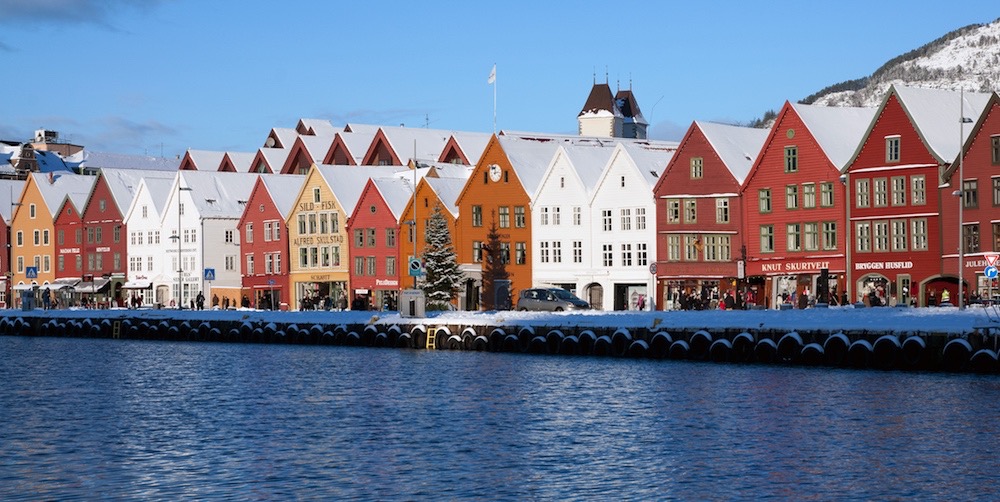
Bergen is the city most often linked to Arendelle's harbour town. The comparison holds up: a working harbour backed by mountains, with a row of painted timber warehouses along the water at Bryggen.

Which places in Norway inspired Frozen?
The places most often linked to Frozen sit in western Norway, along the Sognefjord and around Bergen, with a few further afield. Disney's team has spoken about Norway as a whole rather than naming every location, so treat these as the places most commonly connected with the film.
| Place | The Frozen connection | Where it is |
|---|---|---|
| Nærøyfjord | Often cited as the model for the fjord around Arendelle | A narrow arm of the Sognefjord, between Flåm and Gudvangen |
| Bergen and Bryggen | Most often linked to Arendelle's harbour town | Norway's west coast |
| St Olaf's Church, Balestrand | Widely cited as the model for the chapel where Elsa is crowned | The north shore of the Sognefjord |
| Borgund Stave Church | Stave churches shaped the castle's steep rooflines and shingles | Lærdal, inland from the Sognefjord |
| Akershus Fortress | Often named as an influence on the castle; the art team visited a castle in Oslo during research | Oslo harbour |
| Geirangerfjord | Named in some accounts as Arendelle's fjord | Sunnmøre, further north |
The Nærøyfjord and the Geirangerfjord together make up the West Norwegian Fjords World Heritage site, listed by UNESCO in 2005. Bryggen, Bergen's old Hanseatic wharf, has been on UNESCO's World Heritage List since 1979.
St Olaf's Church, Balestrand
St Olaf's has a story of its own. Knut Kvikne, of Balestrand's Kviknes Hotel, built it in 1897 in memory of his English wife, Margaret. It belongs to the Anglican Chaplaincy in Norway and was built in the style of a stave church rather than in the Middle Ages. Visitors are welcome.

Borgund Stave Church
The medieval stave churches are older and plainer in spirit. Only around 28 survive in Norway. Borgund, built around 1180 and owned by the National Trust of Norway since 1877, is often described as the best preserved, with tiered roofs and carved dragon heads. Stand beneath it and you can see where Arendelle's castle found its shape. Visitor numbers inside the church are limited, so check opening times and booking requirements before you go.

What in Frozen comes from Norwegian culture?
Much of Frozen's character comes from everyday Norwegian craft, music and folklore, not only the scenery. Children often recognise it once they see the real thing.
- Rosemaling. This painted folk art of flowing floral scrolls decorates Arendelle's walls, furniture and costumes. The film uses it to set the sisters apart: Anna wears light floral motifs, and when Elsa leaves Arendelle, snowflake patterns replace the rosemaling on her dress. Folk museums such as Norsk Folkemuseum in Oslo and Maihaugen in Lillehammer show painted rooms and chests up close.
- Trolls. Frozen's mossy, rock-like trolls come from a long Norwegian tradition of troll stories, still told in the mountains and sold in souvenir shops across the country.
- The nøkk. The water horse in Frozen 2 draws on Nøkken, the water spirit of Norwegian folklore.
- Vuelie. The choral piece that opens Frozen is by Frode Fjellheim, a South Sámi composer based in Trondheim. It is built on joik, the traditional Sámi vocal form, and sung by Cantus, a women's choir from Trondheim.

How is Frozen 2 connected to the Sámi?
Frozen 2 travels beyond Arendelle into an enchanted forest, home to the Northuldra, a fictional people inspired by the Sámi. This time Disney worked with Sámi representatives from the start.
The studio signed an agreement with the Saami Council and the Sámi parliaments of Norway, Sweden and Finland. A six-member Sámi advisory group, Verddet, worked with the filmmakers, and a North Sámi version of the film, Jikŋon 2, was released alongside the English one. The Sámi Parliament of Finland has published the background to the collaboration.
The Northuldra are fictional. Sámi culture is very much present today, across northern Norway, Sweden, Finland and Russia's Kola Peninsula.
Frozen 2 also looked beyond Norway. Iceland's black sand beaches are said to have shaped some of its coastal scenes, and families who want to follow the films further can explore Iceland and Finland with us.

When is the best time to visit Norway for Frozen?
It depends whether your children want Arendelle in summer or Arendelle under Elsa's spell. Both are real, and they feel like different places.
| Season | What you'll find | Worth knowing |
|---|---|---|
| Summer (June to August) | Long light evenings, green valleys, full waterfalls, fjord cruises and easy walks | The busiest time; Flåm can be crowded on cruise-ship days, so overnight stays help |
| Winter (December to March) | Snow on the mountains, waterfalls frozen against the Nærøyfjord's cliffs, calm water and far fewer people | Daylight is short, and some facilities in Flåm close in December and January |
| Shoulder (May and September) | Quieter fjords; snowmelt fills the waterfalls in late spring | Weather is changeable |


If snow matters, look inland. Bergen is mild and wet for a Norwegian city, and snow there is never certain. The railway across the mountain plateau and the inner fjords are far more reliable for a white landscape.
In December, Bergen adds something of its own. Since 1991, local kindergartens, schools, businesses and volunteers have built Pepperkakebyen, a gingerbread model of the city and one of the largest gingerbread towns in the world. It opens from mid-November through the Christmas holidays, and profits go to charities for children.

The Northern Lights that flicker across Frozen's sky are rarely seen in the western fjords. For a chance of seeing them, head north of the Arctic Circle between September and March, and see our Northern Lights trips. Clear, dark nights help, but sightings are never certain.

How do you plan a Frozen trip to Norway with children?
The classic rail and fjord route between Oslo and Bergen passes several of the places above, and it suits children well if you take it slowly. Done in a single day, it is a long chain of connections. Spread over several days, with nights beside the fjord, there is time for the scenery to sink in.
The Flåm Railway is a natural highlight for children. It drops about 860 metres (2,820 feet) over 20 kilometres (12 miles), through 20 tunnels, and its gradient makes it the steepest standard-gauge railway in Europe. From Flåm, a fjord cruise carries you into the Nærøyfjord.

Ways to travel with us:
- Highlights of Norway. Four days from Oslo to Bergen between April and October, with the Flåm Railway and a Nærøyfjord cruise.
- Highlights of Norway in Winter. Five days from Oslo to Bergen between December and March, with the Flåm Railway, a Nærøyfjord cruise, and a winter fjord safari or, from February, a snowshoe walk. A luggage porter takes your bags from Oslo to Bergen, which helps with children.
- Highlights of Sognefjord. Four days between May and October, with a night at the Kviknes Hotel in Balestrand, steps from St Olaf's Church.
- Family adventures. Our wider collection of trips designed with families in mind.
Our destination specialists can also tailor a trip around your family, adding Borgund Stave Church, extra days in Bergen or a stretch further north for a chance of the Northern Lights. Every trip is supported by our 24-hour emergency team while you travel.
Frequently asked questions
Was Frozen filmed in Norway?
No. Frozen is animated, so nothing was filmed on location. Disney's art team researched Norway in person, and its fjords, stave churches and folk art shaped how Arendelle looks.
Is Arendelle based on Bergen?
Partly. Bergen is the city most often linked to Arendelle's harbour town, but Arendelle draws on Norway as a whole rather than one place.
Which fjord is Arendelle's fjord?
The Nærøyfjord is most often named, with the Geirangerfjord mentioned in some accounts. Both are UNESCO World Heritage fjords. The Nærøyfjord is the easier of the two to include on an Oslo to Bergen journey.
Can you visit the church from Frozen?
Yes. St Olaf's Church in Balestrand, widely cited as the model for the coronation chapel, welcomes visitors. Donations towards its upkeep are appreciated.
Can you see the Northern Lights in Norway with children?
Possibly, though rarely in the western fjords. The best chance is north of the Arctic Circle between September and March, on clear, dark nights. No one can promise a sighting.
When should we go for snow?
Between December and March, inland and in the mountains. Bergen itself is often wet rather than snowy.
Further reading
- All our travel inspiration
- Norway articles
- Family travel articles
- Which Highlights of Norway trip suits you?
- My Norwegian family adventure: Highlights of Sognefjord
- Norway's most popular fjord views
- When is the best time to visit Norway?
About the author
Satu Vänskä-Westgarth is Director of Product at 50 Degrees North. Finnish by birth, she has made Norway her home for more than 15 years. She shapes our Norway journeys, including the rail and fjord routes of the west and winter trips in the Arctic north.