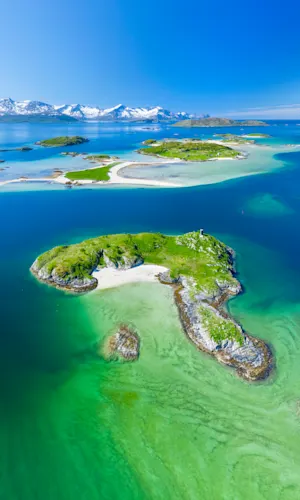
Lofoten Islands
An archipelago of mountains, fishing villages and open Atlantic landscapes, sitting well above the Arctic Circle with a climate that defies expectation.
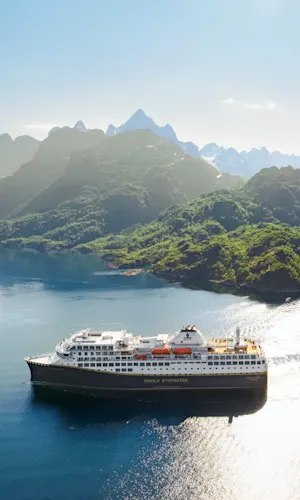
The Lofoten archipelago stretches into the Norwegian Sea from the Nordland region of northern Norway, sitting between the 68th and 69th parallels, well above the Arctic Circle. It is one of those places where the geography alone stops you: mountains rising up to 1,000 metres directly from the water, narrow fjords cutting between islands connected by bridges and tunnels, and a coastline that shifts constantly between sheltered bays, open sea and white sand beaches.
The climate surprises most visitors. At this latitude you might expect harsh conditions year-round, but the North Atlantic Current keeps temperatures remarkably mild, well above what other places at the same latitude experience. This warmth sustains an extraordinary richness of marine life, including the Røst Reef, the world's largest known deep-water coral reef, lying some 100 kilometres west of Røstlandet at depths of 300 to 400 metres.
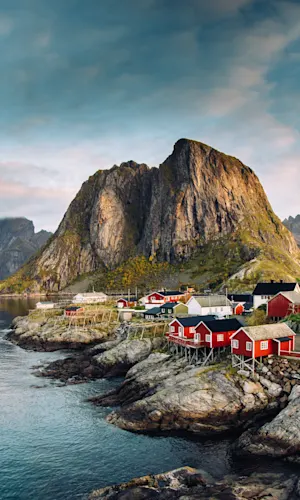
Fishing has defined life in Lofoten for more than a thousand years, and many of the traditional communities remain active rather than merely picturesque. Henningsvær, spread across a cluster of small islands connected by a road that runs out across open water, has galleries, good restaurants and a working harbour that has not been reorganised for visitors. Svolvær is the main town and practical base for the archipelago. Reine, on the island of Moskenesøya, sits at the foot of some of Lofoten's most photographed peaks. Å, at the very end of the road on Moskenesøya, is as far as the archipelago goes: a small cluster of historic rorbu fishing cabins at the edge of the open sea.
Staying in a rorbu, the traditional red-painted fisherman's cabin on stilts over the water, remains one of the most direct ways to connect with the character of these islands. They are available across the archipelago in varying degrees of comfort.
Activities range from hiking and sea kayaking to RIB safaris for sea eagle spotting, cycling and cold-water surfing. The Lofotr Viking Museum at Borg, on Vestvågøy, is built around a reconstructed Iron Age chieftain's longhouse and offers one of the most grounded encounters with Norse history in Norway.
The midnight sun runs from late May through mid-July, when daylight is effectively continuous and the quality of light at midnight is unlike anything most travellers have encountered. The northern lights are visible from September through to April on clear nights, when the mountains provide dramatic foreground for the aurora.