



Anniversary trip ideas in the Nordics
An anniversary asks different things of a trip than a honeymoon, and the Nordic region, with its turning seasons and old ways of life, is unusually good at marking the years a couple has already shared.
8 days | Independent | Jun-Sep | Tromsø to Lofoten
The road from Tromsø via Senja to Reine in Lofoten can easily be rated as one of the most picturesque summer drives in all of Norway. The stretch is connecting numerous larger and smaller islands of the outer North Norwegian coast, and does not pass over any of mainland Norway. You could call it island-hopping by car. The drive includes two ferry crossings and several bridges and underwater tunnels.
The drive is slow, not only due to the narrow roads and the low speed limit, but mainly because of the many photo stops you are likely to make. Every bend in the road portrays another majestic fjord, fishing village, a white sandy beach or a spectacular mountain peak.


As a Certified B Corporation, 50 Degrees North has designed this itinerary using handpicked local hoteliers and suppliers who share our ethos of delivering services and activities of high social and environmental standards.
Through our Climate Action Plan, we measure our carbon emissions each year and set goals to reduce them. But our responsibility does not end when the journey does. A share of our annual profits goes to our Impact Fund, supporting conservation, restoration and the communities we work in.
Car hire 8 days incl. unlimited mileage, GPS and CDW.
(Drinks paid locally)
Please note: We have not included all evening dinners (half-board) in our Norwegian countryside self-drive itineraries but in some spots, the hotel you are staying at may be the only option and/or highly recommended. Norwegian countryside hotels often have well known restaurants or intimate family run dining rooms that the hosts take great pride in. Considering the price of meals in Norway we have left this flexible in case you choose to self-cater. Please ask us for our recommendations as determined by your final itinerary. You do need to book ahead for these evening meals.
Arrive in the Arctic Capital of Tromsø where you will pick up your rental car. Take the ferry to the island of Senja - one of those places in Norway that sees very few visitors. This is mostly due to its dramatic and remote location on the Norwegian coast. On arrival on Senja we highly recommend a detour to Husøy, where the houses are wired down on a little island to avoid being blown away.
Driving further northwest Senia will offer views towards the Devil’s teeth mountain range, and the Oxhorn Mountains. The names themselves indicate the ruggedness of the scenery awaiting you. The road you are travelling is part of a project called the National Tourist Routes of Norway. The Norwegian road authority (Statens Vegvesen) has commissioned 50 architects to design various landmarks, rest stops and view points along chosen road stretches all over Norway. On this particular stretch across Senja you will see Tungeneset and Bergsbotn.
Your accommodation on Senja is in self-contained apartments overlooking the water and sheltered from the open seas of the Norwegian Sea.
Bergsfjorden, just North of Hamn, offers up scenic contrasts of shapes and colours that constantly shift with the changing weather. Steep, majestic mountain dive straight into the sea, and pearly white beaches of crushed sea shells line the islands in the clear turqoise waters. If your lucky you can also get close views of seals, eagles and sea birds. Though the views are almost Caribbeanesque, the temperature will likely remind you that you’re actually North of the Polar circle. On the other hand: warm summer days can bring the temperatures as high as 25°C.
You’ll get a guided tour of the area and enjoy this area from its best side. Be prepared for rosy cheeks and salt water in your hair!
Your accommodation on Senja is in self-contained apartments overlooking the water and sheltered from the open seas of the Norwegian Sea.
Start early with the drive from Hamn via the village of Torsken (the Cod) to Gryllefjord where you will cross the fjord by ferry to Andenes on Andøya. You may be lucky and see whales and seals on the ferry trip.
On arrival at Andenes you will make your way south for the approx. 100km drive to Vestaerålen. Once again, the drive is stunning with mountain peaks rise and chalk white beaches.
On arrival in Vestaerålen check into Kvitnes Gård a 15 room property with beautiful views located at the foot of the Møysalen mountains. This evening indulge in the hotel's tasting menu comprising of a variety of dishes. The dining experience takes around 4 hours.
Make your way south through incredible scenery as you travel along the Lofoten copastline all the way to Svolvær at the bottom of the archipelago.
On arrival in Svolvær you check into your own Rorbu (fisherman’s cottage) on stilts over the clear blue water. The cottages are self-contained with a bed & bathroom, lounge and kitchenette.
Spend the day in Svolvær and enjoy a sea eagle safari by boat and visit the narrow waters of the Trollfjord.
Join a fun RIB trip to the magical Trollfjord where you can see the sea eagle up close. RIB driving is a fantastic experience in itself, but in Lofoten this activity really comes into its own. The trip starts from the quayside in Svolvær up through Raftsundet and into the Trollfjord, one of the country's most dramatic landscapes.
Continue further out in the Lofoten Archipelago to picture perfect Reine. On the way we strongly recommend a stop in the small fishing village of Nusfjord – perhaps for lunch. We can also highly recommend a stop in Flakstad. The Viking Museum is also well worth a visit for a great insight into the Viking culture.
Stay overnight in Reine, in your own self-contained Rorbu.
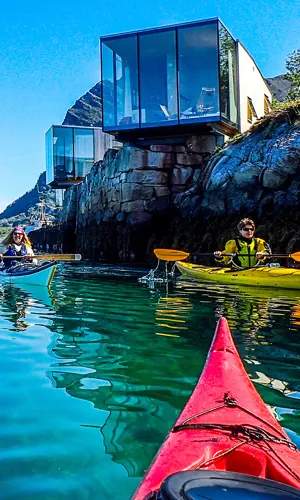
Get up close to the dramatic landscape of Lofoten on a guided kayak tour.
Reine Rorbuer is located in the heart of Reine, affording direct access to one of the most beautiful fjords in the world, the iconic Reinefjorden. As you paddle out into the fjord, you’ll experience small islands with bird colonies, wild shores, and white beaches, all surrounded by majestic mountains. A nature experience not to be missed.
Make the drive to Leknes Airport, or back to Svolvær where you can drop off your car either at the airport or in Svolvær town.
All prices listed are per person, based on two people sharing a room.
Note: The last ferry from Gryllefjord to Andenes is 23rd September 2025
Driving in Norway during the peak season (July - early August):
Europeans love driving in Norway and during the summer months, the more popular tourist roads becomes crowded with European vans. This can slow the roads down, as it can be difficult to pass these vans. Norwegian country roads are often quite narrow. Having said this, these roads are incredibly scenic and have lots of picnic & photo spots.
If you are going to be using ferries during your drive, depending on the size of the ferry, this might involve a wait to get on. The ferries are reliable and regular but you may need to arrive early to secure a spot in the line. On some of the ferries, we suggest considering catching a ferry outside of the peak times. Your accommodation hosts can help with suggestions for your following days travel with the most up to date local information.
SUSTAINABLE TRAVEL:
Tromsø, also known as the Arctic Capital or the ‘Paris of the North’, is the gateway to the Arctic and Northern Norway. It has been awarded as a ‘Sustainable Destination’, which is the Nordic region’s only national labelling scheme for travel destinations. It is a “tool for sustainable development of businesses and destinations when it comes to the environment, the local community, the cultural heritage, and the economy” Nordic regions awarded this title are not perfect, but they are working collaboratively to achieve a long-term goal. These regions are evaluated every three years to ensure they continue to adhere to these standards.
When staying in Tromsø you will stay in a hotel renowned for its’ environmental efforts. The hotel is ISO 14001 certified (which is given to enterprises that have a high-quality environmental managing system for organizational performance), has launched plastic free initiatives in partnership with WWF, where possible is powered by renewable energy and are taking great strides to reduce water consumption and reduce the use of chemicals. Even though access to water is not an issue in Norway compared to other parts of the world, this hotel is conscious of the energy consumed for heating, and chemicals required for purification, so reduction makes up part of their overall environmental policy. In addition to this they provide sustainable, organic, fair-trade food, and only use sustainably produced palm oil. Your hosts also encourage guests to eat less meat and substitute this for plant-based alternatives.
Senja, your main location for this trip, is also going through the process of becoming an accredited ‘Sustainable Destination’. Visit Norway in recent years named your accommodation in Senja as one of the most attractive accommodations in Norway, and it’s not hard to see why. The beautiful location of the site, nestled in the wilderness high above the Arctic circle, offers a unique diversity and a deep experience in nature throughout the year. Your activities for your stay have been selected as low carbon options which allow our visitors to appreciate their time in nature, such as our Northern Lights snowshoeing walk through light-pollution free wilderness, or our guided wildlife boat safari to learn more about the wildlife of the region and support its conservation efforts.
IMPORTANT NOTE: Weather conditions may occasionally affect certain activities, and as a result, the schedule may be adjusted to ensure the best possible experience for all guests. For multi-activity stays, often the order of the activities will be confirmed locally on arrival. Activities might vary slightly in their duration or location due to the weather and local conditions. Any activities that are unable to be re-scheduled due to weather conditions will be refunded as a general practice, as determined by the activity provider.

An anniversary asks different things of a trip than a honeymoon, and the Nordic region, with its turning seasons and old ways of life, is unusually good at marking the years a couple has already shared.

Where and when to see the sun that doesn't set, with dates for Lofoten, the North Cape, Finnish Lapland, Greenland and Svalbard.

Explore 13 of Norway's most memorable viewpoints, from the mountains of Sognefjellet to the Arctic coast, as you travel the country's scenic roads by car.
Travel insurance is compulsory for all tours with 50 Degrees North. The safety of our travellers, staff and operators is a major priority of 50 Degrees North. With an operational office in Norway, 50 Degrees North has access to an up-to-the-minute flow of information regarding the countries we work in. We are also in regular contact with the various operators we use. Their in-depth knowledge and understanding of their various areas is vital.
Written by Jayde Kincaid, an Australian who married a Norwegian, and was happily (albeit with some hesitation) introduced to a world of Norwegian every day food habits.
At 50 Degrees North, we want to encourage our travellers to try local Norwegian food and drink. This may seem daunting in Norway, where restaurants and cafés can be expensive and some of the more remote villages have limited options. There is certainly no street food. One of the best ways to sample local flavours without stretching the budget is by self-catering. You will find friendly locals in small town grocery stores and supermarkets who are happy to help you pick out ingredients. Don't be shy, ask. And don't rush: make the local supermarket part of your holiday experience. Read the notice boards, and enjoy an ice cream out the front when you have finished. It is what the locals do.
Note: Statoil cups - Circle K petrol stations sell a reusable travel cup that gives you free refills of coffee, tea and hot chocolate at any Circle K station. A handy way to save money as you drive around Norway.
Norway has an extensive range of grocery stores, and in most small villages you will find at least one, sometimes two or three. Opening hours are limited, and most chains are closed on Sundays, with the exception of Bunnpris. Weekend hours are usually displayed in brackets on the sign out front. If you are heading into the mountains or along a remote coastal route, stock up with staples before you leave a larger town.
A few tips:
Meatballs or “meatcakes’: these come in all shapes, sizes and quality. They are generally really tasty, a step up from what you find at IKEA. Pick up a packet of dried ready-made brown sauce to go with them, and look out for lingonberry sauce or jam to serve alongside. Lingonberries are the little red circular berries served quite tart. If you want to make the brown sauce yourself, buy some brunost (brown cheese) and follow the recipe at the bottom of this page.
Hotdogs: known as pølse in Norwegian, hot dogs are the definitive fast food of Norway. They are sold at petrol stations, newsagents, corner stores and fast food outlets, and come with a dazzling variety of toppings and breads. Highlights include the bacon-wrapped variety sprinkled with dried onion, mustard and mayonnaise. You will also find them wrapped in waffles, mostly in and around Fredrikstad, or in lompe, the Norwegian flatbread pancake. Like Norwegian beer, pølse comes in seasonal varieties, with Christmas pølse (julepølse) appearing in the weeks before the holidays. Steer away from the tinned varieties.
Fish cakes: these come in many variations and are generally served with a white sauce and plenty of parsley. Often found in fish shops, fried or steamed and ready to eat. A great quick snack.
Reindeer: if you are travelling in the far north, try reindeer meat. It generally comes frozen, so look for finely cut reindeer in the freezer section. It is more expensive than other meats but absolutely delicious, if quite gamey. Fry it with mushrooms, a little brown cheese and rømme (crème fraîche), a bit like a beef stroganoff. Serve with boiled potatoes or rice.
Mushrooms: if you are travelling during the chanterelle season in mid to late August, look for the yellow mushrooms in the pine forests. You can pick them yourself, but image search them first so you know what you are looking for. They are wonderful with the brown cheese sauce and reindeer.
Salmon, prawns & fish: always look out for a chance to buy fresh fish. Look for local fish kiosks or fish shops, or small roadside signs pointing to fresh fish sales. The words to look for are reker (small shrimps, not prawns) and fersk fisk (fresh fish). Norwegian shrimps are small, sweet and harvested from the cool North Sea. Peel them and pile them on fresh white bread with mayonnaise, dill, pepper and salt. Norwegian smoked salmon is exceptional. Try the different varieties where you can, and in larger supermarkets or delis you can often taste before you buy.
Tubed ‘kaviar’ (caviar): cheap, practical and a genuine Norwegian staple. This is the thing Jayde's Norwegian husband craves the way an Australian abroad craves Vegemite.
Pre-made dips and salads: Norwegian supermarkets carry a wide range of premade salads and dips with a reasonable shelf life, ideal for sandwiches and picnics. The cubed beetroot salad and potato salads are particularly good. They come in easy-to-carry containers and tubed mayonnaise travels well too. Leverpostei (liver pâté) is also worth trying, served on brown bread with sliced red onion or sweet pickles. It is found on most Norwegian breakfast tables.
Yoghurt: a small warning here. Norwegian yoghurt comes in styles ranging from thick and creamy to very runny and sour. The runny variety sometimes comes in a carton that looks exactly like a milk carton. Sour runny yoghurt is not nice in your coffee. When in doubt, ask a local.
Bread: supermarket bread in Norway generally comes uncut. There are bread cutting machines near the bakery section in most stores, and staff are happy to help the first time. The bread can be fairly plain in the main supermarkets, so look for boutique bakeries in larger towns if you enjoy something more interesting. Keep an eye out for lefse, the Norwegian flatbread similar to a soft tortilla, usually served with butter and sugar, sometimes with cinnamon, and occasionally made with potato.
Waffles: Norwegian waffle stalls are the equivalent of a sausage sizzle. They are the most common community fundraising food and turn up everywhere. Do not expect sweet jam and whipped cream. These are fresh, chewy waffles served with sour cream and homemade tart berry jam. Never walk past one.
Chocolate: try Freia milk chocolate while you are here. It is genuinely excellent.
Berries: in early autumn, roughly mid to late August, the forests come alive with berries. Ask a local where to look and head up into the hills. You may find blueberries, lingonberries, raspberries, and if you are in the far north or the central mountains, the rare and prized yellow cloudberry.
On a self-drive journey, always slow down for small farm shops and roadside stands.
Strawberries: if you are travelling during strawberry season, stop. Norwegian strawberries, grown in soil that has rested through a long winter, are extraordinary. If you pass a self-pick farm, put everything else on hold and go in. Norwegians wait all year for this.
New potatoes: look for new season potatoes sold in small stands beside the road, often on an honesty system where you take a bag and leave the money in a tin.
CLASSIC RECIPE: brown cheese sauce
Basic Brown Cheese Recipe – can be used with meatballs, reindeer, with added mushrooms.
• 2 tablespoons butter
• 2 tablespoons flour
• 3⁄4 cup light cream
• 1⁄2 cup chicken broth (optional - just use water if you cannot find this)
• 1 cup shredded gjetost or brown goats cheese
• 3⁄4 cup rømme (crème fraiche)
• 2 tablespoons chopped parsley or 2 tablespoons fresh dill
Using the pan from your browned meat, remove as much oil as possible and blend in the butter and flour over heat. Remove from heat and blend in the cream. Add the broth, return to heat and bring to the boil, stirring until thickened. Mix in the gjetost. Turn the heat to low. Blend a little of the sauce into the rømme to temper it, then stir it all back into the pan. Add the parsley or dill and serve.
Happy shopping and cooking!