Kiruna
Kiruna - Northernmost Swedish town
Kiruna is the northernmost city in Sweden, sitting 200 kilometres above the Arctic Circle in Swedish Lapland. With a municipality of around 22,000 people, it is an important gateway for travellers exploring the far north of Sweden and the neighbouring regions of Norway and Finland, and the starting point for many of 50 Degrees North's winter journeys through Swedish Lapland.
What makes Kiruna unlike anywhere else is a story that has been unfolding for two decades. The city is being moved. LKAB, the state-owned mining company whose iron ore mine dominates the region, warned in 2004 that the ground beneath Kiruna's centre was subsiding, and that the entire city would need to relocate three kilometres to the east to allow mining to continue. The process began in 2014 and is expected to be completed around 2035. In August 2025 it reached a defining moment: Kiruna Church, completed in 1912 and considered one of Sweden's most beautiful buildings, was placed on 224 remote-controlled wheels and moved five kilometres along a specially built road to its new location, with King Carl XVI Gustaf among those watching and Swedish television broadcasting the journey live. The new city centre, anchored by the striking Kristallen city hall designed by Henning Larsen Architects, is already open and functioning.
It is one of the most extraordinary urban transformations in the world, and visiting Kiruna today means witnessing it in progress.
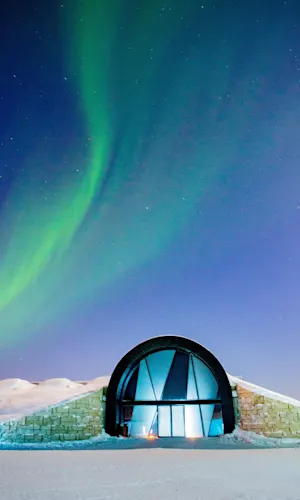
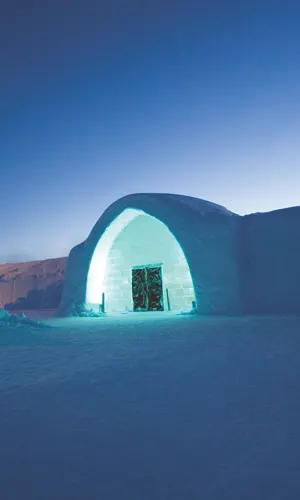
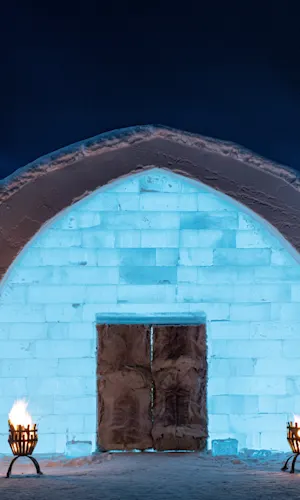
Beyond this, Kiruna has long been a destination in its own right. Kiruna Airport offers regular flights to Stockholm and serves as the main arrival point for visitors to northern Swedish Lapland. From here, the ICEHOTEL in Jukkasjärvi is around 20 minutes away, and Abisko National Park National Park, consistently rated among the world's best places to see the Northern Lights, is around an hour by road or rail. The Nordland railway line connects Kiruna with Narvik in Norway and Luleå on the Swedish coast.
The area has a long history connected to the Sámi people, the indigenous population of northern Scandinavia and Finland, who have lived here for thousands of years. Reindeer herding continues across the surrounding landscape, and Sámi culture and language remain visible throughout the city. The name Kiruna itself comes from the Sámi word giron, meaning snow grouse.
In December 2024, Kiruna was designated European Capital of Culture 2029, under the theme Movement: Below Ground, On Earth, In Space, drawing on the mine, the relocation, and the city's position at the intersection of Swedish, Sámi, and Tornedalian cultures.
Kiruna joins a remarkable cluster of Nordic and Baltic cities to have held the European Capital of Culture title. Read the full story here: European Capitals of Culture in the Nordic and Baltic region